Summer Memorials is proud to welcome Graveside Memorials to our family, continuing trusted care for Saskatoon families.Visit us at our new office at 202 33rd St E, Saskatoon, SK S7K 0S3.
June 5, 2026
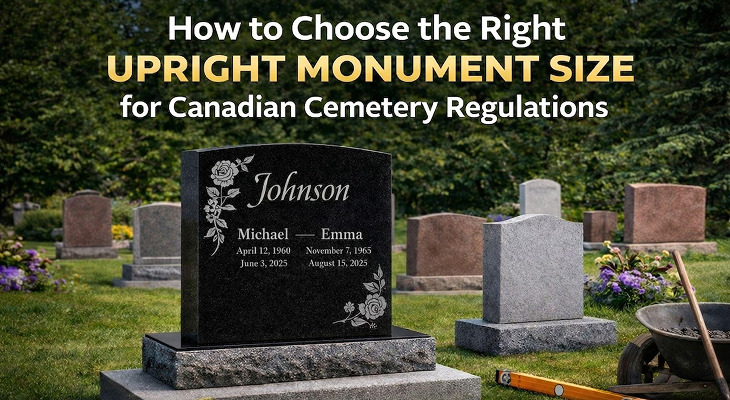
Choosing the correct upright monument size is one of the most important steps in the memorial planning process. Many families focus first on design and inscription. However, cemetery size rules and monument size restrictions must be reviewed before manufacturing begins.
Across Canada, cemeteries establish clear regulations for height, width, base dimensions, and foundation requirements. Ordering a monument without confirming these details can result in delays, redesign costs, or approval issues.
At Summit Memorials, monument sizing always begins with regulatory review. This approach ensures compliance, structural stability, and-long term performance.
This guide explains how to choose the right upright monument size while meeting Canadian cemetery requirements.
Every cemetery operates under defined monument standards. These standards exist to maintain visual consistency, ensure safe spacing, and protect long term stability.
Common regulations address:
Some cemeteries restrict monument height to preserve sightlines. Others limit the base width to maintain uniform alignment across sections.
Ignoring these rules can result in rejected applications or installation delays.
Before selecting granite colour or design style, confirming monument size restrictions should be the first step.
To choose the correct size, families must understand how upright monuments are structured.
An upright monument typically consists of:
Cemetery regulations may apply to each component individually. For example, height restrictions often apply to the die, while width limits may apply to the base.
Summit Memorials reviews each component measurement against cemetery requirements before finalizing production.
Not all cemetery sections allow the same monument dimensions.
Single lots often have smaller width allowances compared to companion or family lots. Some sections permit only flat markers, while others allow upright monuments with defined height limits.
Families should request written monument guidelines from the cemetery. These guidelines usually specify:
Working with an experienced monument provider simplifies this step. Summit Memorials coordinates directly with cemeteries to confirm all dimensional restrictions before manufacturing begins.
Height is one of the most regulated dimensions.
Typical upright monument heights range between 24 inches and 42 inches above ground. However, each cemetery may set its own limits.
Height must account for both the die and the base. A taller die may require a proportionally wider base to maintain stability and visual balance.
Choosing a monument that approaches the maximum allowed height requires careful structural planning. Granite thickness plays an important role here.
Quality upright monuments are manufactured with a minimum granite thickness of three inches. This thickness supports structural integrity while maintaining compliance.
Granite itself does not crack from freeze thaw cycles. In Canadian climates, properly manufactured granite remains stable. The foundation beneath the monument supports long term alignment.
Base dimensions are often overlooked during early planning.
Cemeteries may restrict how wide a base can extend across a lot. Companion monuments, which accommodate two names, usually require wider bases.
If the base width exceeds the allowed lot space, approval may be denied.
Base depth also affects installation. A properly sized base distributes weight evenly and supports the die above.
Summit Memorials designs bases proportionally to the die while staying within cemetery width limits. This ensures both compliance and visual balance.
Foundation preparation is critical to long term stability.
Cemeteries often specify:
An oversized monument without adequate foundation support can lead to shifting or levelling issues over time.
Professional installation ensures:
Without professional installation, even a correctly sized monument may experience stability concerns.
Summit Memorials includes professional monument installation services to ensure that both size and structural requirements are met.
Monument sizing should also consider future needs.
Companion upright monuments require sufficient width to accommodate two inscriptions. Planning for additional inscriptions later may influence initial size selection.
Choosing a slightly larger die within cemetery limits may provide additional space for future engraving.
Engraving depth also affects legibility. Lighter granite requires deep cut engraving for contrast. Dark granite uses shallow sunk engraving to maintain clarity.
Summit Memorials selects engraving methods based on granite colour to ensure long term readability.
Families sometimes encounter challenges due to sizing oversights.
Common mistakes include:
These issues can lead to approval delays and added costs.
Starting with regulatory confirmation prevents these complications.
Pre-produced monuments often follow standard dimensions. While those dimensions may fit some cemeteries, they are not tailored to specific lot requirements.
Custom manufacturing allows adjustments to:
This flexibility ensures compliance while preserving design integrity.
At Summit Memorials, upright monuments are manufactured to meet confirmed cemetery size restrictions before engraving begins. This approach protects families from resizing after production.
Canadian climates require stable monument construction.
Granite is naturally durable and does not deteriorate from freeze-thaw cycles. However, foundation integrity determines how well the monument remains level over time.
Properly sized monuments distribute weight evenly across the base. This reduces pressure points that could contribute to future levelling adjustments.
Professional installation reinforces long term structural alignment.
Choosing the right upright monument size involves more than selecting dimensions from a brochure.
At Summit Memorials, the sizing process includes:
This structured approach ensures that monuments meet both aesthetic and regulatory expectations.
Selecting the correct upright monument size is essential for approval, stability, and long-term satisfaction.
By confirming headstone size rules early, evaluating monument size restrictions carefully, and ensuring proper installation, families can avoid common setbacks.
Working with experienced monument specialists simplifies the process and protects against compliance issues.
At Summit Memorials, upright monuments are designed and installed with attention to regulatory detail and structural standards. This ensures that each monument meets Canadian cemetery requirements while reflecting the family’s chosen design.
Choosing the right size is not simply about appearance. It is about ensuring that the monument stands properly, complies fully, and remains aligned for generations.
Contact us now and let our experts help you with all the headstone technicalities.