Summer Memorials is proud to welcome Graveside Memorials to our family, continuing trusted care for Saskatoon families.Visit us at our new office at 202 33rd St E, Saskatoon, SK S7K 0S3.
July 28, 2026
The final act of honouring a life extends far into the soil of a Canadian cemetery. A memorial granite stone is a fixed point in time, a tangible connection to heritage. Yet the permanence of that connection relies entirely on a process few families witness: the engineering precision of professional monument installation. At Summit Memorials, we understand that a monument is only as enduring as the foundation upon which it rests. True commemoration is not simply etched into stone, it is rooted deep within the earth, engineered to stand steadfast against harsh climates and the passage of centuries.
When a family invests in a memorial, they envision a perpetual tribute that remains straight, clean, and legible for generations. However, the Canadian landscape presents a uniquely aggressive adversary to this vision. Before crafting the aesthetic finish of granite, one must first calculate the subterranean forces of frost heave and soil expansion. The cyclical freezing and thawing of water-saturated earth generates immense upward and lateral pressure. Without a scientifically engineered installation, even the heaviest stone can tilt, sink, or crack within a few short winters.
Precision monument installation dictates that the visible tribute is merely the tip of an engineered system extending deep below the turf line. At Summit Memorials, our methodology moves beyond the simple digging of a hole. We construct a subterranean anchoring system designed to harmonise with, rather than fight against, the natural hydrology and soil mechanics of the specific plot.
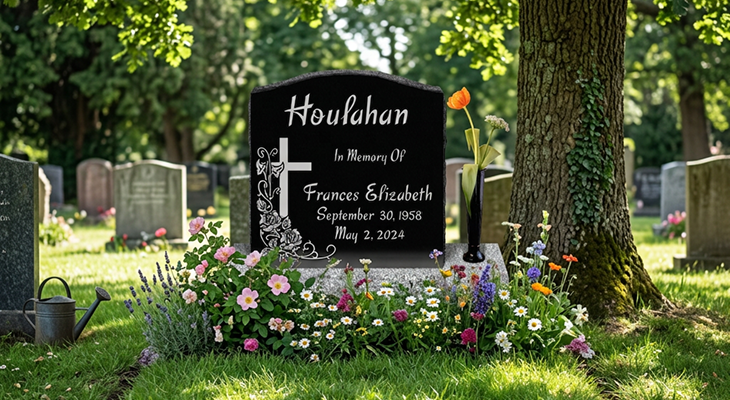
Frost heave remains the single greatest threat to monument longevity in Canada. The phenomenon occurs when moisture in the ground freezes into ice lenses, expanding soil volume by nearly ten percent. This expansion lifts everything above it, including concrete pads and heavy granite. When the thaw arrives, the soil settles unevenly, producing a leaning stone that requires costly resetting and often suffers hairline fractures.
Our installation teams mitigate this risk through a meticulous excavation protocol:
Proper levelling is not achieved with shims and guesswork, it requires high-precision laser levels and an understanding of final grading. A monument that leans even a few degrees off plumb disrupts the visual harmony of a cemetery section and can feel deeply disrespectful.
For upright monuments, the die must sit perfectly plumb on its base, and the base must be flush with the surrounding landscape. This alignment ensures rain sheds cleanly off polished surfaces, preventing ponding that accelerates biological growth and mineral staining. For flat grave markers, the demands are equally stringent:
We fabricate our foundations using rigid forming systems that guarantee square corners and true lines. By compacting the substrate in controlled lifts, we allow for primary settlement so the monument remains geometrically true.
The interface between stone and base is the most vulnerable point in any memorial installation. An amateur approach might rely solely on gravity, placing a heavy block of granite onto a concrete pad. Such an approach ignores the capillary forces that draw moisture into the microscopic gap between the two materials.
A precision installation involves applying a high-strength, non-shrink bedding compound formulated specifically for exterior stonework. This bond acts as both an adhesive and a waterproof gasket, filling the horizontal joint completely to prevent water from seeping under the die. We also apply a colour-matched, breathable penetrating sealer to the granite where specified, allowing internal moisture vapour to escape while repelling liquid water and contaminants.
Every cemetery maintains specific by-laws dictating foundation depth, concrete collar dimensions, and permissible anchoring hardware. These regulations exist to ensure the long-term safety of visitors and the operational efficiency of groundskeeping staff.
When a family works with Summit Memorials, we assume full responsibility for navigating these bureaucratic requirements. We do not ask grieving families to interpret engineering specifications or apply for foundation permits. Our team liaises directly with cemetery administrators to verify:
For families seeking general guidance on burial service standards nationwide, the Government of Canada provides resources through the Office of Consumer Affairs regarding funeral regulations. Our commitment to compliance protects our clients from the distress and financial burden of having a non-compliant monument removed or altered at their expense.
A slender upright tablet carries wind-loading concerns that a low-profile flat marker does not. Similarly, a sloped pedestal marker requires specific drainage provisions to prevent soil washout.
For taller upright dies, the foundation must counteract not only gravity but leverage. Wind pressure against a polished granite face exerts significant torque at the stone-to-base joint. Our installation process accounts for this by:
The installation of flat markers shifts the focus from vertical stability to horizontal integration. We prepare a reinforced concrete pad that extends beyond the marker’s dimensions, creating a stable perimeter. We anticipate future sod growth and organic matter build-up, setting the marker with just enough elevation to remain visible without interfering with mower blades.
The long-term cost of inadequate monument installation far exceeds the initial investment:
At Summit Memorials, we invest the same exacting quality into what is buried as we do into the polished lettering that catches the light. This invisible infrastructure guarantees a straight, dignified silhouette against the prairie sky.
Choosing a memorial is a profound decision that bridges immediate grief with a future where great-grandchildren will trace their fingers over a name carved in stone. Through precision monument installation, Summit Memorials ensures that an everlasting remembrance is rooted firmly in the soil, resilient against the frost, straight against the wind, and flush with the serene landscape. Contact us to learn how our approach to installation preserves not just a name, but a presence, for generations to come.